

Full Menu
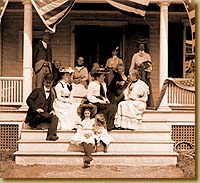 Nassau County Museum Photo It's about 1910, and members of the Raynor family of Rockville Centre are all decked out to celebrate the Fourth of July. Click Here for Pictures Photos from "Long Island To-day" by Frederick Ruther, 1909 |
VILLAGE HISTORY"Gentlemen wishing a county seat will find it to their interest to secure lots in said Village." With development came entrepreneurs who established newspapers, such as "The Picket," first published in 1865, with a distinct anti-South bias. It was "The South Side Observer," a successor paper which first touted the idea of a referendum on incorporation. The Village Green is located on the site of the Wallace home. It is the setting for a variety of special events for residents, including summer concerts, springtime arts festival and holiday programs. The arrival of the railroad in 1867 heralded the entry of Rockville Centre into the modern era. It was now possible to get into New York City faster and more frequently than had ever been possible by stage coach on the Jamaica Plain Road or by sailing ship from East Rockaway. Even before its establishment as a municipality, Rockville Centre enjoyed diverse services, including a volunteer fire company founded in 1875, a public library opened in 1882, and the South Shore's first high school, opened in 1892. South Side High School occupied the building and grounds which now house the Rockville Centre Municipal Building. The high school, now Village Hall, celebrated its 100th birthday last year, and a New York State historic marker in front sets forth the building's place in the history of this Village, and Long Island. The growth of the region, and the importance of Rockville Centre to the area's economy is highlighted by the founding, in February 1891, of the Bank of Rockville Centre, the first commercial bank operated on Long Island's south shore. The bank occupied the corner of Merrick Road and North Village Avenue. Banking was a growth industry in the Village, and by 1929, Rockville Centre had earned a reputation as a leading financial center for the Island. Today, many banking institutions have branches in the Village. As incorporation and self-determination of municipal services dawned, Rockville Centre was a thriving community of 2,000. Village History Reflects Its Growth and StabilityThe date: July 15,1893. The place: Atheneum Hall. The vote: 139 in favor, 79 opposed. With that, the citizens of Rockville Centre, Queens County, State of New York, took the first step toward the home rule and self determination, which today, at 100, make this Village a great place to live, work, and raise a family Even before the citizenry took the momentous step of approving incorporation, Rockville Centre was a thriving south shore community. From its roots as a village for the Reckouackie Indians, to its settlement as Near Rockaway, in the 17th century by Dutch and English pioneers, to its Revolutionary War persona as a hotbed of Toryism, Rockville Centre grew and prospered, so that by 1870, the local press was urging a home rule referendum. New Rockaway included what today is Rockville Centre, as well as Oceanside, Lynbrook, and East Rockaway.Population increased slowly through the 17th century, but with the erection of DeMott's Mill on Smith's Pond, Rockville Centre's position as a commercial center for the south shore began to emerge. The revolutionary fervor sweeping other parts of the thirteen colonies seemed far removed from the inhabitants of Near Rockaway, until June 1776, when a skirmish at DeMott's Mill turned neighbor against neighbor as the forces of independence swept through a fiercely loyalist community. The community stability and growth of services which are the hallmarks of today's Village were also an integral part of its early development as a thriving residential and business center. By the dawn of the 19th century, there were six mills serving the needs of the region's farmers and miners, and the area near what is, today, Lincoln Avenue and Merrick Road, was a developing shopping area, with a variety of tradesmen, including a blacksmith, a carriage maker, a furniture store, a carpenter and an inn. As the century unfolded, perhaps the single most important event, other than incorporation, in transforming the hamlet into the thriving Village it is today, occurred when Robert Pettit, in 1849, applied to the United States Post Office for permission to open a post office in his general store. Several names for this postal address were rejected in Washington, including Smithville, Smithtown, and Rockville, but the addition of "Centre" created what the Post Office agreed was a distinctive-sounding designation. Pettit had chosen the name to honor Mordecai "Rock" Smith, a Methodist preacher and community leader, whose father had operated DeMott's Mill. Smith was a blacksmith, a farmer, and the justice of the peace. Once "Rockville Centre" was on the map, it became the site of real estate development, and newspapers touting its accessibility by stagecoach from New York City, and the existence of postal service, as well as the abundance of shellfish and game, suggested that there were 300 homes, a few stores, two schools with eight teachers, and churches used by Baptist, Episcopalian, Methodist, and Roman Catholic worshippers, in an area of under two square miles. Back in 1925, the Long Island Railroad ran at ground level, through downtown Rockville Centre. Front Street was wide enough at that time to permit two-way traffic with sufficient space in the center to provide some convenient parking for some residents commuting to NYC. The safety and convenience of having the railroad tracks run overhead has narrowed Front Street. The increase in the number of LIRR commuters has been accommodated at the parking fields built by the Village during the forties and fifties in areas near the station. Today, 100 years later, 24,727 residents enjoy life in a thriving community of 3.3 square miles, with 9,200 housing units, more than 400 retail and service shops as well as professional and corporate offices, seven parochial and public schools, a college, and 15 diverse religious denominations. There are over 150 acres of parks, ball-fields and playgrounds, and a municipal government which provides the most comprehensive range of services anywhere on Long Island. Following ratification of the home rule referendum, the first Village elections were held on August 19, 1893, and John Lyon was elected Village President. This title, for the Village's chief elected official was changed to Mayor in 1925, during the tenure of Charles Richmond. Mr. Lyon was joined on the Village Board by Edwin Wallace, Edwin Seabury, Glentworth Combes, Nelson Seaman, and John Runcie. The first Village Board meeting was held on August 26, at the Wallace home on Maple Avenue. The First water and electric utilities building on the south side of Maple Avenue was constructed on land obtained by the Village from Captain Edwin Wallace. Water service started in 1895, and the electric generating plant began operations at that site in 1898. The original steam generator used to pump Village water is on display at the utilities complex on Maple Avenue. Just as the Wallace homestead was at the heart of the Village's activities in 1893, the property on which it stood, now the Village Green, offers the Village a beautiful passive park, and provides a location for those events which help to make Rockville Centre special. These events include the Ragamuffin parade, the arts festival, the summer concert series and the lighting of the Village Christmas tree. As an independent municipality, Rockville Centre government leaders made early decisions that positioned the Village as a leader among Long Island communities, and assured its vibrant growth into the 20th century. The motivating force behind the creation of a municipal water utility was concern for controlling the spread of fires. In 1895, residents approved the levy of a water tax to construct a water system. The Water Department was established on land donated by Trustee Wallace, where it still stands today. Originally, water mains were installed in the downtown business district, and gradually, residential pumping was added to the system. The original wells were about 50 feet deep while water is pumped today from 10 wells nearly 1,000 feet deep, and enters the distribution system under pressure from storage in four towers that collectively hold nearly 4 million gallons. The foresight of the Village's founding fathers is revealed most clearly by their establishment of a municipal electric power plant, in 1898. Originally designed to power street lights, and operated only in the evening hours, the plant, still located on Maple Avenue, is one of three municipal electric utilities on Long Island. At the outset, the power plant averaged 206,182 kilowatt hours of power per year to 285 customers. Today, with the continuing upgrade of the generators, and the Village's access to hydropower supplied by the Power Authority of the State of New York, Rockville Centre's Electric Light and Power provides more than 10,000 residential and commercial customers with approximately 170 million kilowatt hours of power each year, at rates substantially below any other electric utility in the region. The out front philosophy is still evident as the Village works to complete an electric enhancement project which will ensure Rockville Centre's continued access to safe, efficient and economical electric power. Throughout its first 35 years, Rockville Centre grew and prospered. The expansion northward and the advent of residential development in the late teens and early 1920's resulted in the creation of a Building Department, and sewers were installed in the late 20's. In 1926, the Village was one of the first Long Island communities to install traffic lights, and by 1928, the Police Department was completely motorized. In 1929, the first large apartment block was constructed, at the corner of North Village and Hempstead Avenues, where the Tudor Apartments still remain. There were two movie theaters; one of them, the Fantasy, still is open at the same location today. Various bank buildings from that era still dot the Village landscape, albeit the banks which built them no longer exist. The South Shore Trust building remains on North Village Avenue, and presently houses offices; the Nassau County National Bank now serves as a branch of European American Bank, opposite the railroad station on Front Street, and the original office of the First National Bank on Sunrise Highway at Park Avenue now houses the offices of the Roman Catholic Diocese of Rockville Centre, which was identified by the 1990 census as the largest non governmental employer on Long Island. By its 40th anniversary in 1933, the Village had six fire companies and 33 police officers. The diversity in the style and the beauty of architecture at that time earned Rockville Centre the name "The Village of Homes." Interestingly, the commute to New York City, at that time, was 37 minutes, about the same as it is today! The growth of suburbia following the Second World War brought growth to Rockville Centre, too, and by the mid l950's, Village residents could boast of a year-round recreation facility. The success of this municipal service led to the building of the John Anderson Recreation Center in 1962 and the extension of services to the Martin Luther King Community Centre in 1981. In 1986, the Village obtained the 110 acres of Donald Browne Rockville Centre Park from New York State, and that site is presently utilized for picnicking, fishing, and ice skating, as well as Boy Scout Camporees, nature trails and model boat racing. The year-round programs attracted 1900 boys and girls, ages 5 to 18, in 1956; today's extensive recreation schedule of classes, events, and facilities' use is enjoyed by every age group, from toddler to senior citizen. In 1992, more than 10,000 residents utilized the Recreation Center and the Village's parks. During the mid-50's, the Village built commuter parking fields, and augmented existing lots to provide space for the explosion of automobiles experienced in the post-war period. It successfully urged the State to complete the rerouting of the Sunrise Highway/ Merrick Road intersection, to eliminate a hazardous entry into the Village, and it approved preliminary plans to eliminate substandard housing in the west end of the community. Changing needs motivated the Urban Renewal projects of the 1960's, and spawned the creation of a Senior Services staff to serve the needs of Rockville Centre's growing aged population in 1979. Although 100 years "old" in 1993, the Village government continues to emphasize resident services and to provide for the upkeep of its infrastructure. Professional management, electric enhancement combined with affordable rates, drainage improvement, water system upgrade, advanced fire alarm and police response mechanisms, clean, safe, and attractive streets, recycling to protect the environment and save taxpayer monies, modern physical plants and facilities for the efficient delivery of services, abundant recreational opportunities, and attention to the special needs of its citizens combine to keep Rockville Centre a youthful and yet mature community. As the Village looks to its second century, Rockville
Centre is truly a great place to live, work and raise a family! |
